


























Views
Downloads

Skip Counting by 6s Worksheet | Grade 2 Essential Math
Paste this activity's link or code into your existing LMS (Google Classroom, Canvas, Teams, Schoology, Moodle, etc.).
Students can open and work on the activity right away, with no student login required.
You'll still be able to track student progress and results from your teacher account.
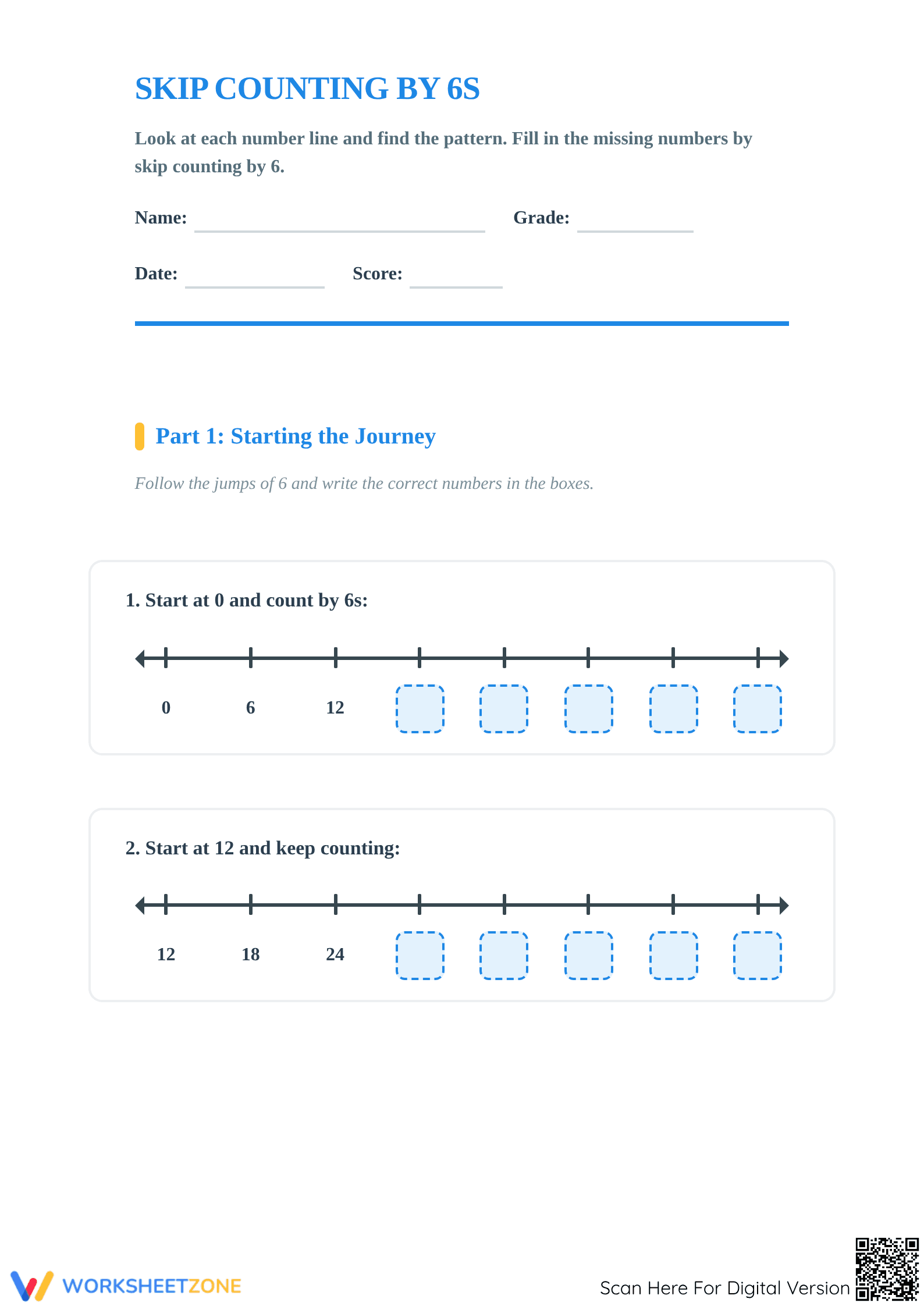
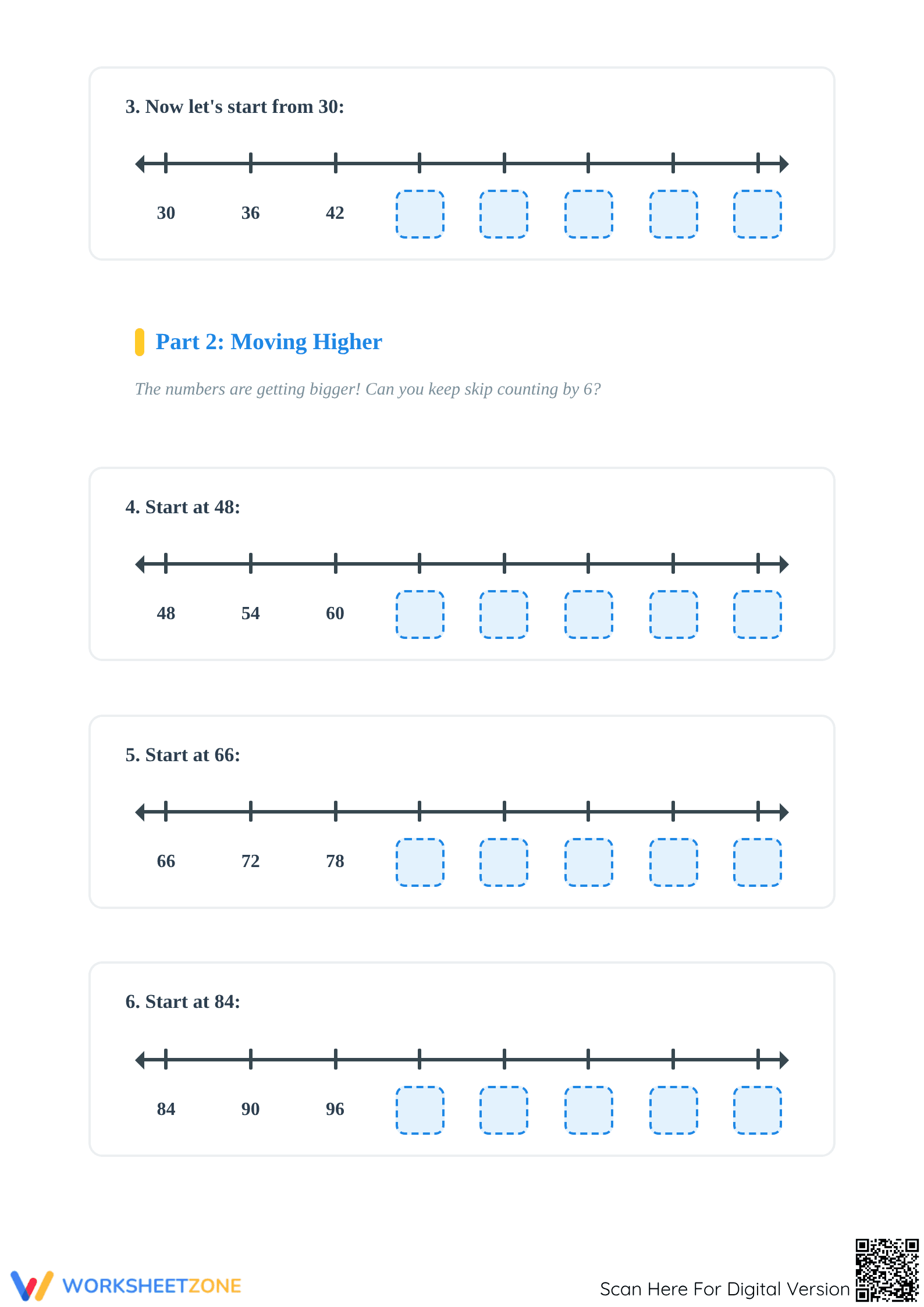
Students build critical mental math foundations by mastering patterns in numbers. This worksheet provides structured practice for skip counting by 6s using visual number lines to help learners internalize the relationship between addition and multiplication. By visualizing the "jumps" on a line, Grade 2 students develop the numerical fluency required for advanced arithmetic.
At a Glance
- Grade: 2 · Subject: Math
- Standard:
2.NBT.A.2— Count within 1000 and skip-count to build pattern recognition and numerical fluency- Skill Focus: Skip counting by 6s on number lines
- Format: 3 pages · 8 problems · Answer key included · PDF
- Best For: Independent math centers and remedial support
- Time: 15–20 minutes
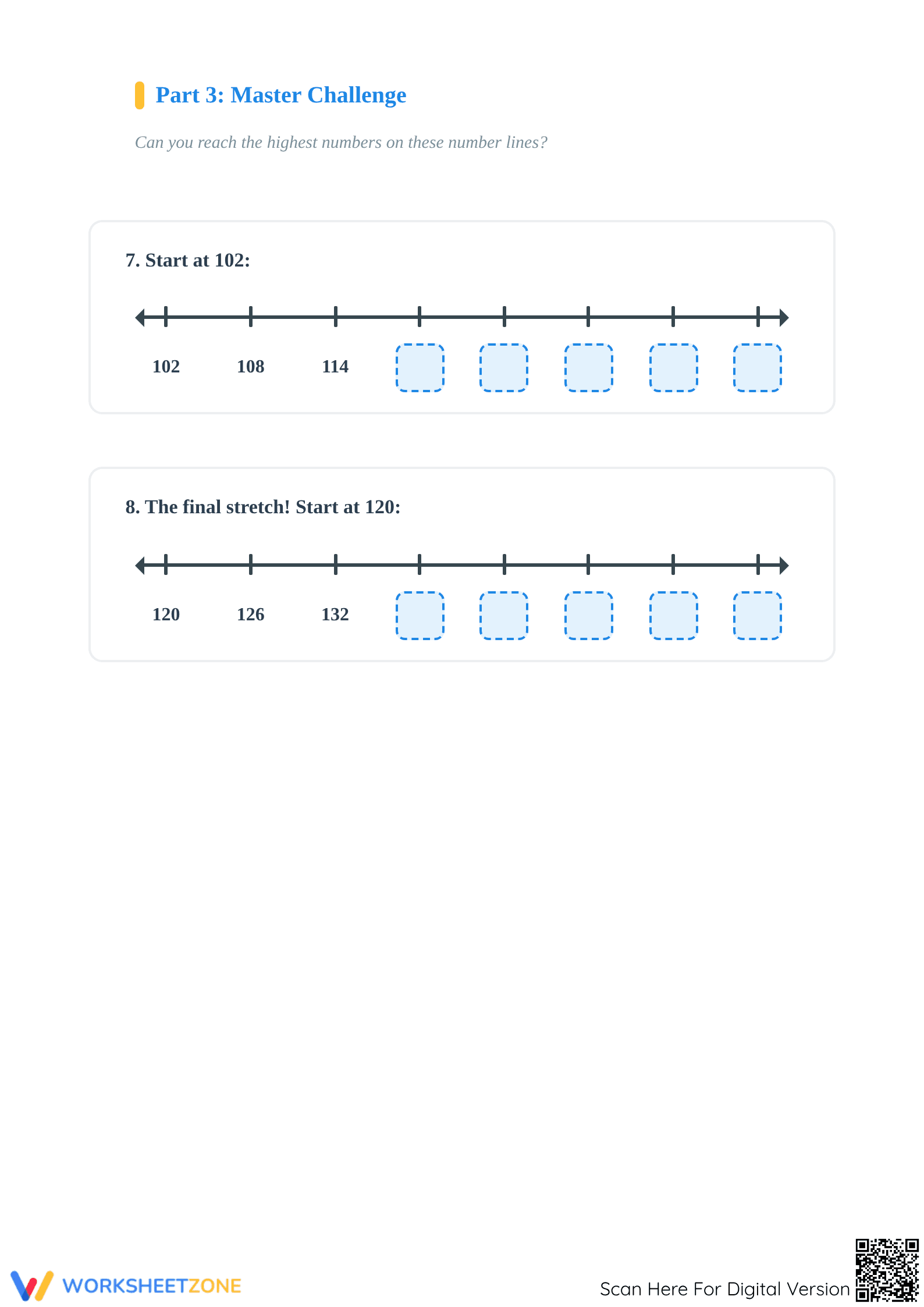
This comprehensive three-page PDF features eight distinct number line tasks. The resource is divided into three logical phases: "Starting the Journey" (introductory patterns), "Moving Higher" (intermediate sequences), and the "Master Challenge" (advanced counting up to 150). Each problem includes a clear number line with boxes for students to input their answers, alongside a full answer key for rapid grading.
The worksheet is designed for immediate classroom deployment with a zero-prep footprint. Teachers can print the three-page set in less than one minute. Distribution to students takes mere seconds, making it an ideal choice for morning work or unexpected substitute plans. Total teacher involvement for setup is under two minutes, allowing you to focus on active monitoring and providing real-time feedback during the 20-minute completion window.
This resource aligns with `2.NBT.A.2`, which focuses on counting within 1000 and skip-counting by various intervals. While the standard explicitly mentions 5s, 10s, and 100s, skip-counting by 6s is a vital extension that prepares students for the third-grade multiplication tables. This standard code can be copied directly into lesson plans, IEP goals, or district curriculum mapping tools to ensure rigorous instructional alignment.
Utilize this worksheet as a formative assessment after introducing the concept of repeated addition. As students work through the "Master Challenge," observe their ability to maintain the pattern when crossing over the hundred-benchmark; this is a prime instructional moment to catch "off-by-six" errors. It also serves as an excellent independent center activity to reinforce numerical sequences while you work with small intervention groups.
This resource is specifically tailored for Grade 2 students working toward fluency, though it remains a valuable review for Grade 3 learners struggling with multiplication concepts. The visual support of the number line makes it accessible for English Language Learners and students with IEP accommodations. Pair this worksheet with a 120-chart or physical manipulatives for students who require additional concrete scaffolds before moving to abstract number lines.
Research from EdReports (2024) emphasizes that procedural fluency in early mathematics is best developed when students can visualize numerical relationships through varied representations like number lines. This skip-counting by 6s worksheet adheres to these findings by bridging the gap between basic counting and the multiplicative reasoning required in later grades. By requiring students to complete eight sequential number lines, the resource provides the necessary repetition to move patterns from short-term memory into long-term mathematical schemas. According to recent NAEP data, students who exhibit strong skip-counting skills often outperform their peers in multi-digit addition and subtraction tasks. This document enables educators to provide evidence-based practice that directly addresses standard 2.NBT.A.2, ensuring that every student has the opportunity to master the foundational skip-counting skills essential for algebraic readiness and overall quantitative literacy in the modern classroom.


